

Missouri is home to some of the largest freshwater springs in the country. Millions of gallons of water bubble up from deep within the earth each day, creating brilliant blue pools and sparkling streams. Short paths and hiking trails will guide you to more than a dozen of these breathtaking spots.
A Top Spring State
The Show-Me State has one of the highest concentrations of freshwater springs in the United States. More than 4,400 springs are located across southern Missouri, primarily in the rugged terrain of the Ozarks. The springs range in size from tiny trickles to pools more than 50 feet in diameter. Others emerge as fast-moving streams from the base of rock bluffs and the mouth of small caves.
The cold-water springs originate hundreds of feet below ground and maintain an average temperature of 56-58 degrees year-round. The high mineral content, depth and clarity of the water give springs their vibrant color – shades of blue that range from teal to turquoise.
Visiting Missouri’s Springs
The largest springs in Missouri are located in national park areas and forests as well as state parks and conservation areas. Many of the springs flow into some of Missouri’s most scenic rivers – crystal-clear streams popular for canoeing and kayaking. Although swimming and fishing are prohibited in many of the larger springs, you can swim and fish in the nearby spring-fed rivers. Fishing is also allowed in several of the spring runs or branches – the small streams that flow from the head of the spring. If you’re planning to cast a line, you will need a state fishing license.
A road trip is the perfect way to explore the beauty of Missouri’s freshwater springs. Be sure to follow the guidelines for each spring to help protect them for future generations to enjoy.
Big Spring
Hundreds of springs flow into the Current and Jacks Fork rivers in the Ozark National Scenic Riverways, the first national park area in the country to protect a river system. Big Spring, located 4 miles south of Van Buren, is one of the three largest springs in the United States. It’s an impressive sight with an average daily flow of 286 million gallons of water that feed the Current River. A short accessible walkway leads to the spring. The Big Spring Slough Trail, a 1.2-mile accessible loop, includes exhibits about the area’s history and habitats. Picnic areas and a campground are nearby.

Blue Spring
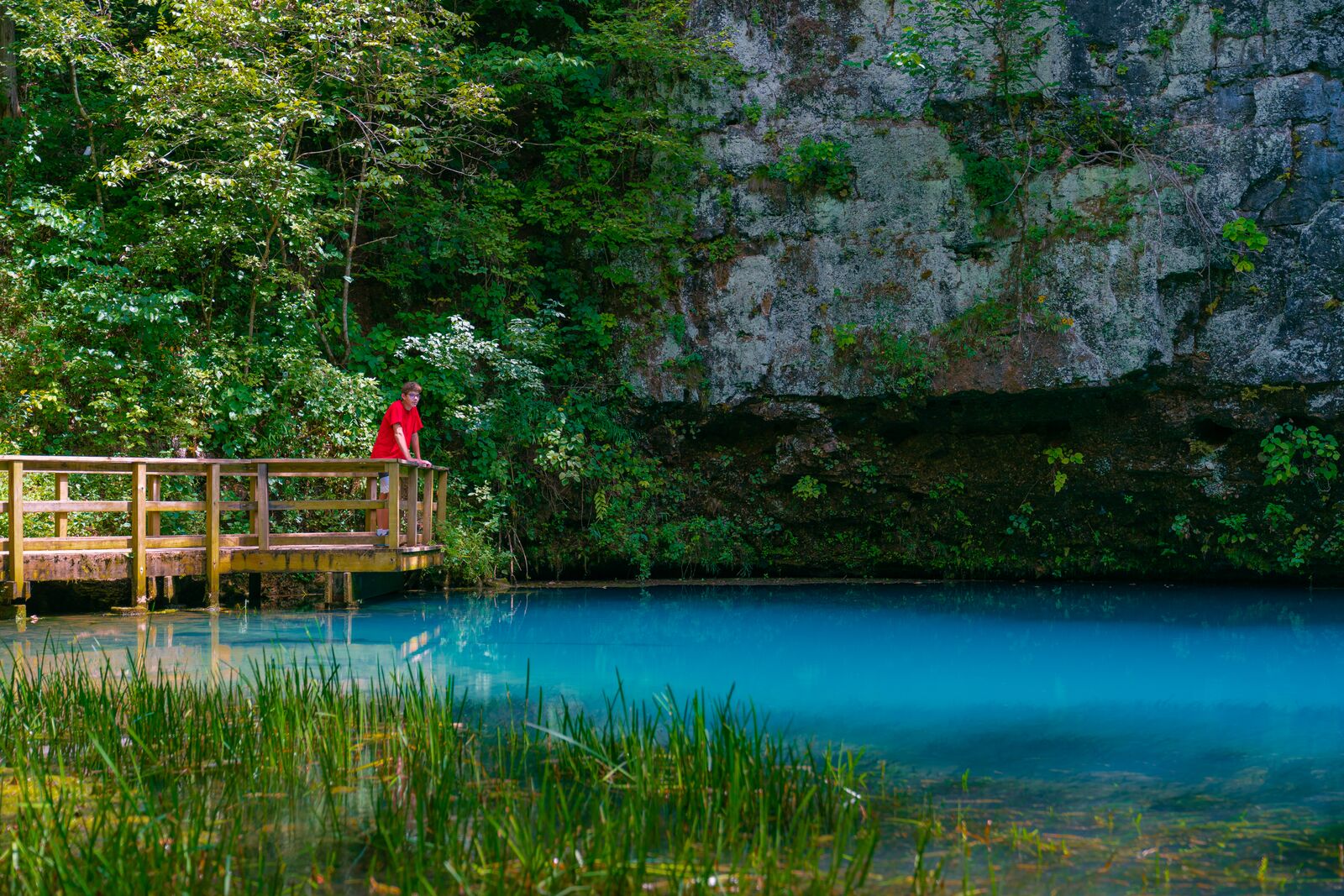
Hike a half-mile (round trip) to Blue Spring – with water a shade of turquoise you have to see to believe. Osage Tribe members reportedly called it “Spring of the Summer Sky.” Missouri’s sixth largest spring produces more than 90 million gallons of water a day. Walk onto the wooden deck at the edge of the pool and peer into one of the country’s deepest springs. If you were to submerge the Statue of Liberty in the 310-foot-deep pool, her torch would be five feet below the surface of the water. The spring, 14 miles east of Eminence, is part of the Ozark National Scenic Riverways.
Alley Spring
The state’s seventh-largest spring, Alley Spring – also located in the Ozark National Scenic Riverways – pumps out more than 80 million gallons of water each day. The three-quarter-mile Spring Branch Trail circles the spring, 5 miles west of Eminence. The Alley Spring Overlook Trail, a 1.5-mile loop, includes a steep climb to an overlook with views of the valley. Historic Alley Mill sits at the edge of the teal-blue spring and is one of the most photographed spots Missouri. The grounds include picnic areas, a historic one-room schoolhouse and restored general store. A campground is located a short distance away.

Welch Spring
Another large spring in the Ozark National Scenic Riverways emerges from the ground along the bank of the Current River. Welch Spring, Missouri’s fifth largest, produces an average of 78 million gallons of water a day. In addition to its natural beauty, the spring is known for the ruins of a “hospital” that sit beside it. The structure was built in 1913 over the mouth of cave from which the spring emerges. It was believed that the spring water had healing properties and the cool, pollen-free air coming from the cave would benefit patients as well. The best way to see the spring is by canoe or kayak via the Current River or an eight-tenths of a mile (round trip) hike on the Welch Spring Trail. The trail begins at the Welch Landing Access Point north of Van Buren.
Greer Spring
Trek along a picturesque trail to reach Greer Spring, the state’s second largest, churning out 210 million gallons of water daily. The spring water rushes from the mouth of a cave, creating a powerful stream that feeds the Eleven Point River, more than doubling the flow of the river. Greer Spring Trail, a nearly 2-mile (round trip) hike, is located in Mark Twain National Forest, about 8 miles north of Alton.

Roaring River Spring
Roaring River State Park in the southwest corner of Missouri is home to Roaring River Spring, the deepest spring in the United States. At 472 feet deep and counting, the bottom of the spring has yet to be discovered. More than 20 million gallons of water flow from the spring into Roaring River every day. A short, paved walkway leads to the spring. The park boasts seven hiking trails that vary in difficulty and is one of three Missouri state parks stocked for trout fishing by the Missouri Department of Conservation. The park offers picnic areas, hiking trails, a campground, cabins, a lodge and a restaurant.

Ha Ha Tonka Spring
Follow the 1.4-mile Spring Trail to reach Ha Ha Tonka Spring, Missouri’s 12th largest spring. Located in Ha Ha Tonka State Park at Lake of the Ozarks, the trail starts at the edge of the lake and travels alongside rock bluffs to the spring, which has an average daily flow of 58 million gallons of water. Beyond the spring, the loop trail ascends 316 steps and provides spectacular views. The park includes more than a dozen hiking trails, fascinating geological features, including a natural bridge and sinkholes, and the remains of a historic stone “castle” built in the early 1900s. There’s also picnic areas and a fishing dock on the lake.
Maramec Spring
Trout fishing attracts thousands of visitors to Maramec Spring Park each year, but you don’t have to be an angler to enjoy the scenery. The centerpiece of the park is the spring, the fifth largest in Missouri, producing an average of 100 million gallons of water daily. Located 7 miles southeast of St. James, the park includes picnic areas, hiking trails, a campground and a cafe. In addition to Roaring River State Park and Meramec Spring Park, you can find significant springs at other Missouri trout parks including Bennett Spring State Park and Montauk State Park.
Additional Information
Visit Springs | Missouri Department of Conservation (mo.gov) for more information about how springs form and their importance in Missouri.