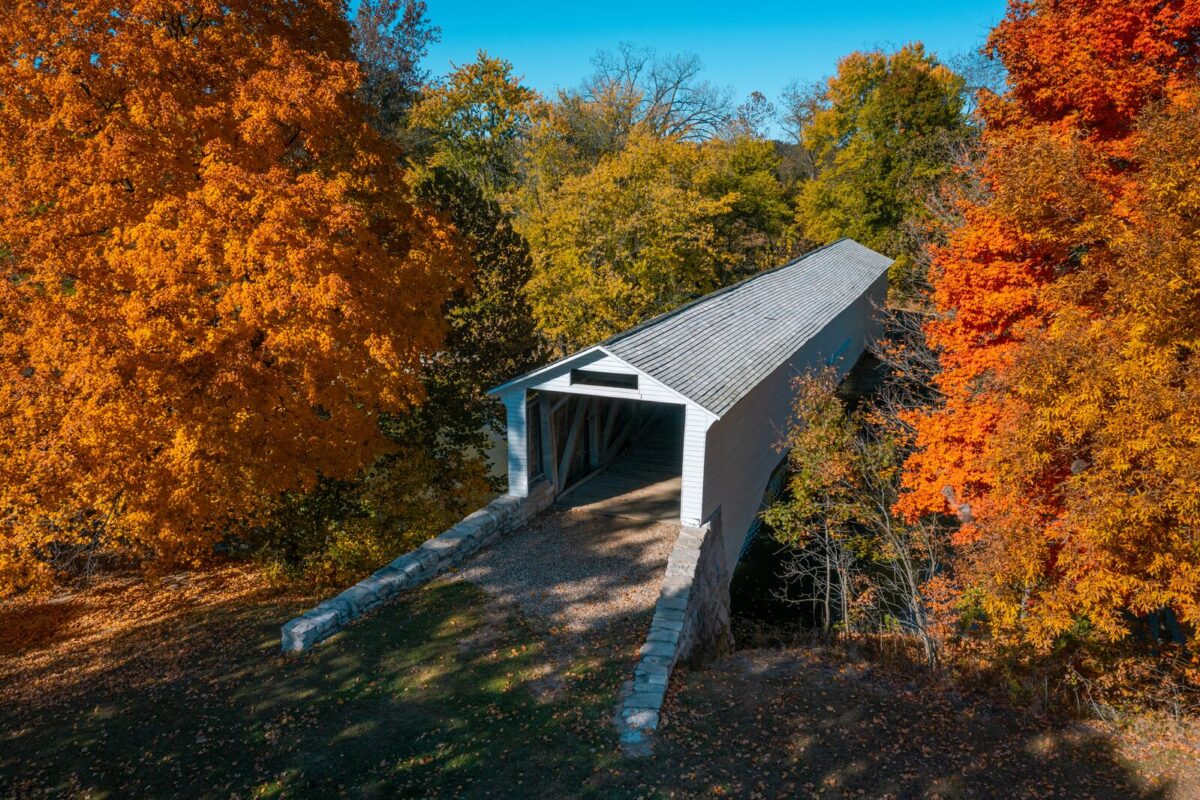
An estimated 30 covered bridges once spanned many of Missouri’s rivers and creeks, providing vital links to travelers. Today, Missouri’s four remaining covered bridges only serve as reminders of days gone by. Although there were many advantages to the shelter with the roof and sides, the main purpose behind covering bridges was to protect the intricate structural network of iron and timber trusses from the weather. The coverings also added strength, which reduced sagging and listing. Riders in uncovered buggies and carriages often used the bridges as shelters from the wind, snow and rain.
Bufordville Covered Bridge
Burfordville Covered Bridge, located within Bollinger Mill State Historic Site, is the oldest remaining covered bridge in Missouri. Joseph Lansmon began its construction in 1858. After the Civil War, the bridge became a vital link, especially to farmers driving wagonloads of grain destined for the mill.
The bridge exhibits Howe-truss construction, named for William Howe, who patented the design in 1840. The essential feature of the design was its use of vertical iron rods to draw the diagonal wooden members tight against the top and bottom of the truss. The Howe-truss span was built mainly of yellow poplar. Burfordville Covered Bridge, which spans the Whitewater River, is 140 feet long and has a clearance 14 feet high and 12 feet wide.
Sandy Creek Covered Bridge
Sandy Creek Covered Bridge, located in Hillsboro, Missouri, was constructed by John H. Morse in 1872 as part of a countywide building program in Jefferson County following the Civil War. After taking a stroll across the bridge, visitors can learn more about the history of the bridge on the outdoor interpretive display, then sit and enjoy a picnic lunch in the shaded picnic area near the bridge. The red barnlike appearance of the bridge and the natural setting surrounding it make an ideal scene for photographs or paintings.

Locust Creek Covered Bridge
At 151 feet, Locust Creek Covered Bridge is the longest of Missouri’s four surviving covered bridges. It was built in 1868 and became a link in one of the nation’s first transcontinental roads, Route 8. The bridge was made of white pine using the Howe-truss system. The essential feature of this design is the use of vertical iron rods to draw the diagonal wooden members tight against the top and bottom of the structure. In 2025, Locust Creek Covered Bridge was moved to the day-use area within Pershing State Park.
Union Covered Bridge
Union Covered Bridge, built in 1871, is the only one of the four remaining covered bridges that represents the Burr-arch truss design. It served travelers in Monroe County for 99 years and is a peaceful spot to visit or stop and relax. The bridge is in picturesque Paris, Missouri, and is a perfect place for pictures.